Municipal solid waste collection
Collect the same containers with fewer vehicles, fewer trips and fewer kilometres. Routes live in the system, not in the field supervisor's memory.
About a third of the shift is not spent collecting.
In Türkiye, collection routes are mostly set by the field supervisor's experience and the driver's initiative. In the real data of a metropolitan district municipality, 30.9% of a 7.5-hour shift goes to non-value-adding activity: trips to and from the disposal site, unnecessary driving and waiting.
- When vehicles are hired per job, every unnecessary trip hits the budget directly.
- Uncollected containers are the most visible cause of citizen complaints.
- When the supervisor is away, the route knowledge is away too.
How it works
Upload your data
Container locations and the vehicle list are uploaded with a KML or Excel template.
Define your constraints
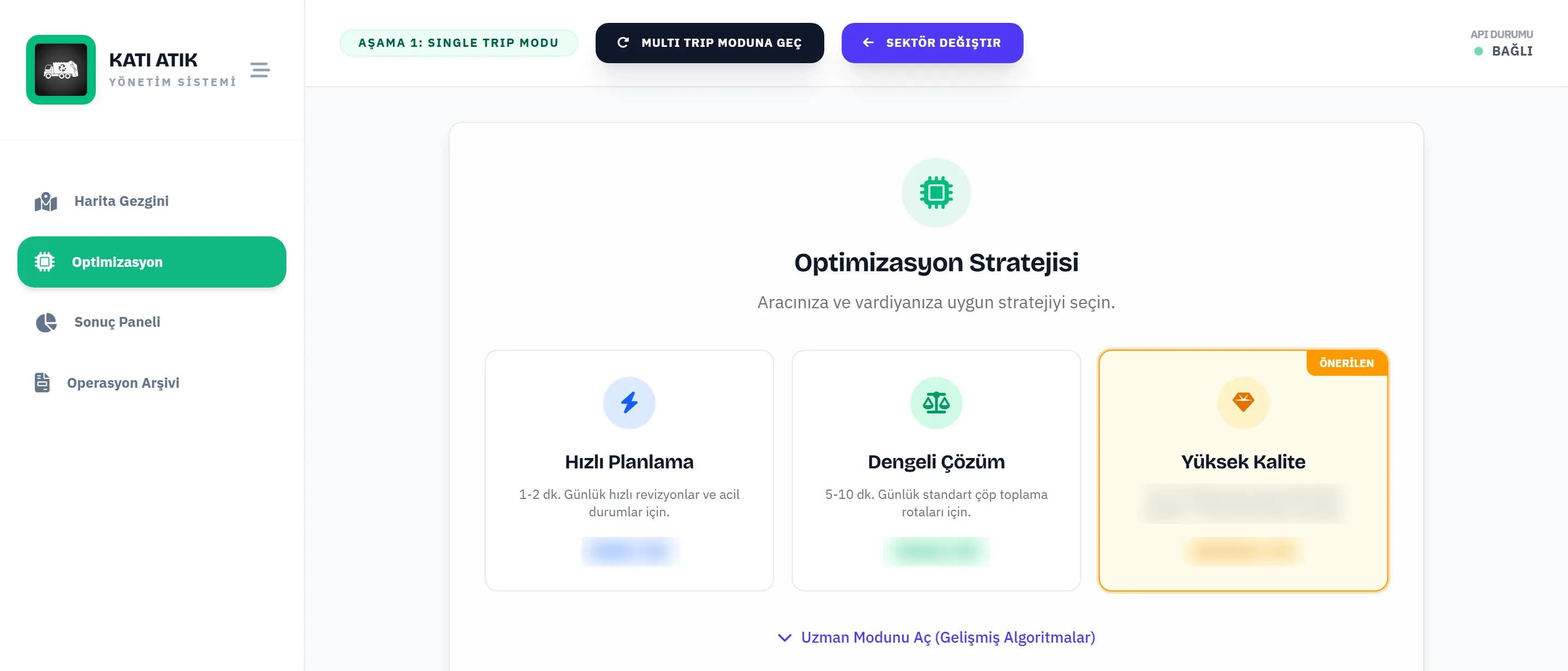
Vehicle type and capacity, container-vehicle compatibility, shift length, disposal site and multi-trip settings are defined in the interface.
Get the routes and the report
On the 27-vehicle shift data of a metropolitan district, a district-wide plan was produced in under 20 minutes; the time depends on the number of points and vehicles. Distance, time, fuel and CO₂ per vehicle can be exported to Excel and PDF.
Rules specific to collection operations
Route software built for parcel delivery does not include these rules. Akılkent's model is built around them.
| Constraint | What it means |
|---|---|
| Heterogeneous fleet | Compactor and crane trucks have different capacities and speeds; they are planned together. |
| Container-vehicle compatibility | Underground containers get a crane truck; incompatible assignments are never generated. |
| Disposal site returns | When a vehicle is full it goes to the disposal site and continues its route; the round trip is in the plan. |
| Shift length | The plan stays within the shift; no overtime is created. |
| Multiple trips | Where there is a transfer station, a vehicle can make more than one trip per shift. |
| Full coverage | Every container is assigned to a vehicle. If capacity or shift length is insufficient the plan is not forced: unassigned containers are listed separately and the additional vehicle need is stated. |
Result: a report you can present to management
Distance, time, fuel and CO₂ per vehicle are reported for every plan; at the end of the shift, planned and actual values are compared. Vehicle-level emission data feeds directly into the greenhouse gas inventory expected from municipalities under the Climate Law.
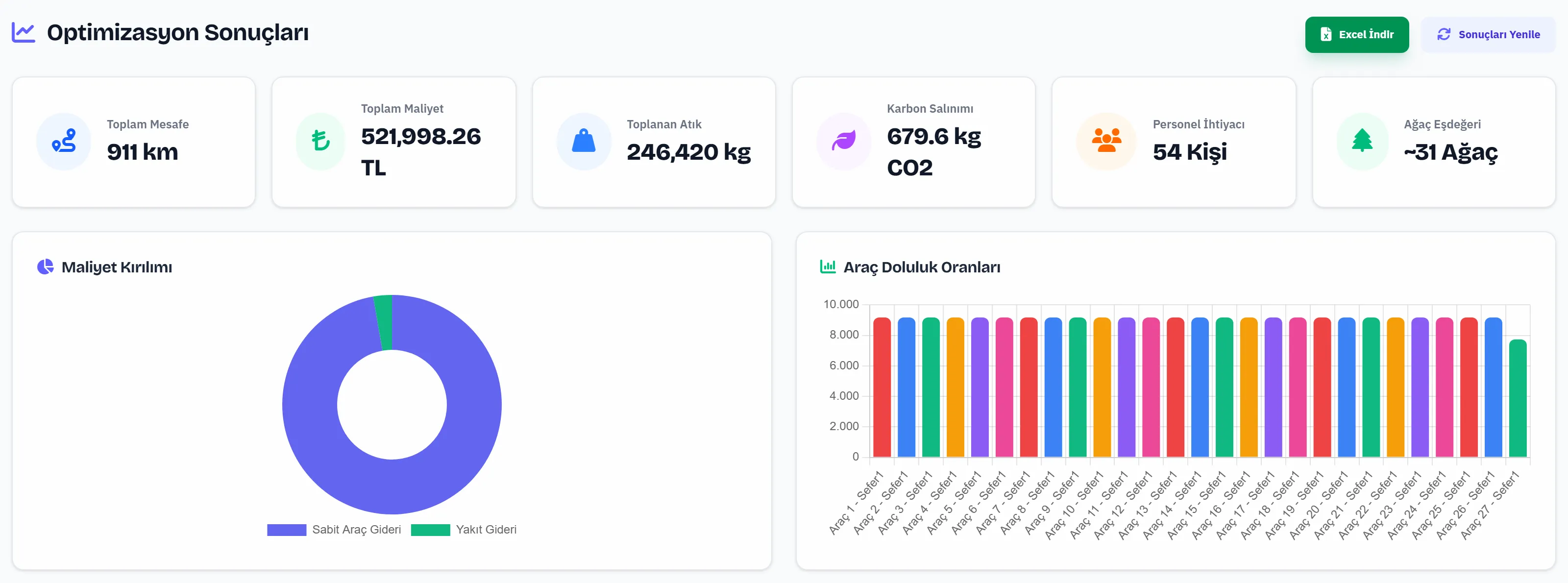
- Non-value-adding time
- 30.9% 6.2%
- Fuel consumption and emissions
- 34.5% reduction
- Container coverage
- 100%
Figures come from a model analysis of a metropolitan district municipality's real data; the method was validated against exact solutions on small instances. Savings realised in the field will be measured in a pilot.
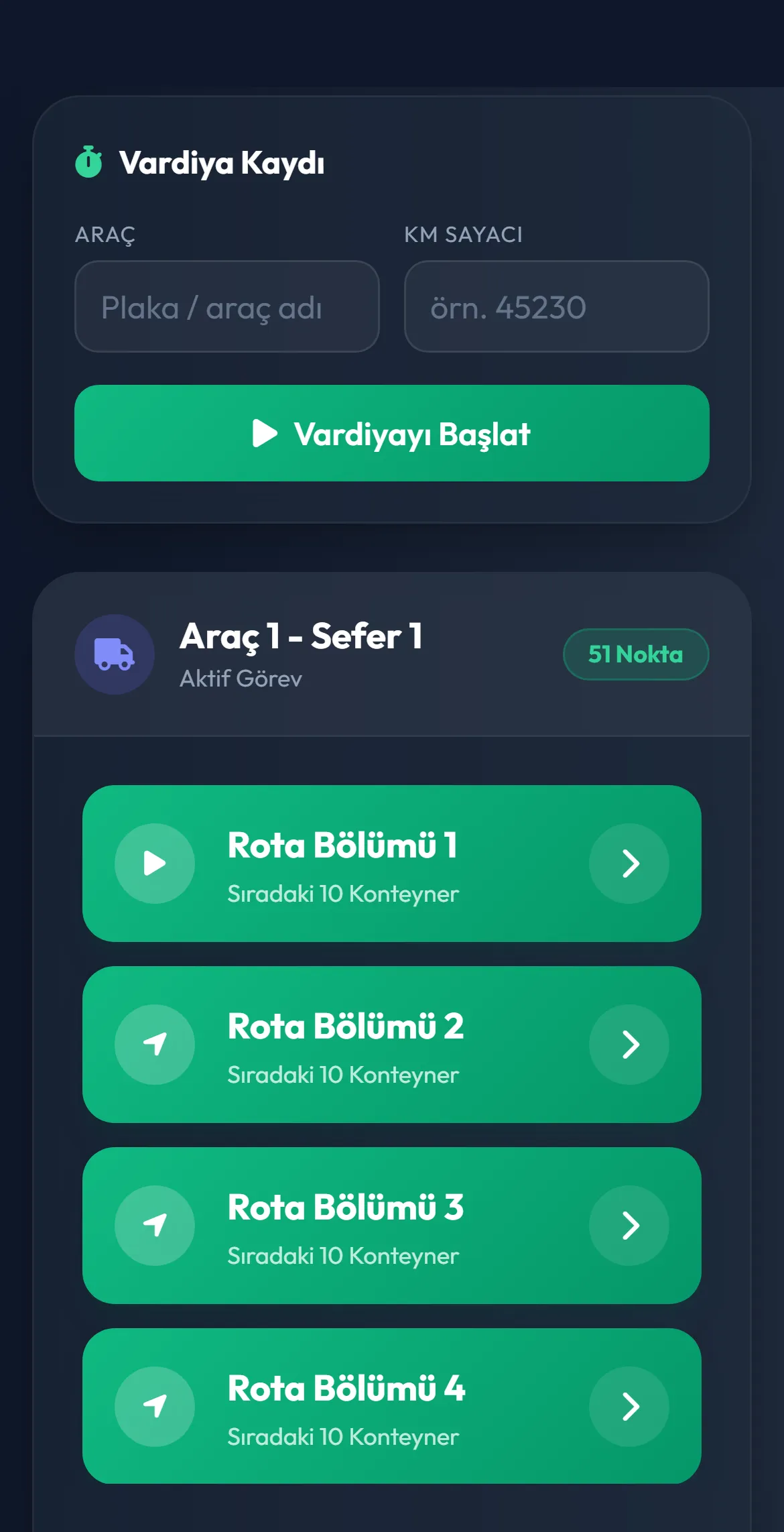
The driver follows the job on a phone.
At the start of the shift the vehicle and odometer reading are entered. The next containers are sent to the map application ten at a time, and each container is marked empty, half, full or overflowing when collected. The shift record is added to the report.
If the connection drops, the marks are held on the device and sent when it returns.
Getting started without waiting for a tender
Free pre-analysis
With your vehicle list and container locations we prepare a savings potential report within 2–3 weeks. You see the results for your own district before deciding.
Pilot in one zone
A few months of operation in a single zone. Planned routes are driven in the field and realised savings are measured. The pilot package is designed to stay within direct procurement limits.
District-wide rollout
The transition is based on measured results. Inventory transfer, road network preparation and staff training are included; the process takes weeks.
Regulatory fit, domestic software and in-country data
| Regulation | In Akılkent |
|---|---|
| Personal Data Protection Law (No. 6698) | The municipality is the data controller, Akılkent the processor. Role-based authorisation, access logging and encryption apply; a data processing agreement is signed. |
| Information and Communication Security Circular (2019/12) | Public data stays in Türkiye: hosted in a domestic data centre or installed on the institution's own server. |
| Climate Law (No. 7552) | Vehicle-level fuel and CO₂ data feeds directly into the municipality's greenhouse gas inventory and climate action plan. |
| 2030 National Smart Cities Strategy | Aligned with the goals of data-driven optimization of waste collection routes and domestic solutions. |
Data from your existing vehicle tracking systems can be imported; devices in the field are not replaced.