Which vehicle goes to which point, in which order?
Akılkent prepares the daily route plan for any field operation with vehicles and points to visit: municipal sanitation crews, used cooking oil and liquid waste collectors, street cleaning, maintenance crews, distribution fleets. It weighs vehicle capacity, working hours and unloading or delivery points together, and works with your existing fleet.
Request a free pre-analysisNo technical knowledge or new devices needed. See how to start →
Same 12 points, back and forthSame 12 points; in this diagram 61% of today's road
TOBB ETÜ Industrial Engineering graduation project and poster first prizes
First place in Türkiye among 106 teams at the YAEM 2026 Congress
TÜBİTAK BİGG 1812 start-up programme
Planning with your existing vehicle and collection point data
Upload the data, build the routes, get the report.
The operator panel works in three steps; no knowledge of algorithms is needed.
- Upload the data. The vehicle list and point locations are uploaded with a KML or Excel template.
- Build the routes. You set the shift hours and time constraints; the plan is ready in minutes and shown on the map.
- Get the report. Distance, time, fuel and CO₂ per vehicle; downloadable as Excel and PDF.
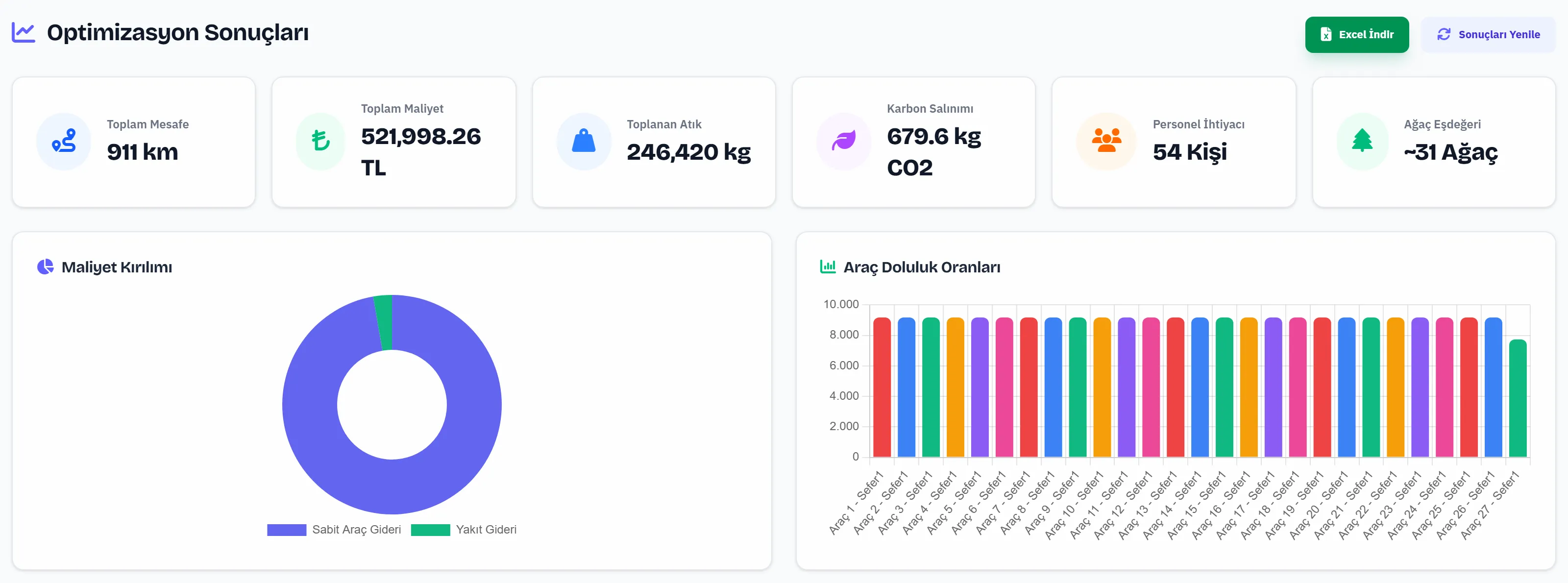
Potential computed with real data
A model analysis on the vehicle, container, shift and road network data of a metropolitan district municipality.
- Shift time spent outside collection
- 30.9% 6.2%
- Fuel consumption and emissions
- 34.5% reduction
- District-wide route generation (27-vehicle shift data)
- under 20 min
These values come from a computer model analysis; they are not measured field savings and not a guarantee for your organisation. The method won first place in Türkiye among 106 teams at the YAEM 2026 Congress. Savings realised in the field will be measured in a pilot.
How does it help your collection operation?
First we talk about what you collect, where, and how your vehicles work. Then we assess together whether planning fits your operation.
Our focus areas
Municipal solid waste
Collection route planning for sanitation departments. Different vehicle and container types, disposal site returns and shift lengths in one plan. Validated with the real data of a metropolitan district.
Used cooking oil collection
For companies collecting used oil from restaurants, hotels and canteens. Tank capacity, visit frequency and unloading at the facility are part of the plan; only full points are visited.
Parcel, distribution and collection fleets
For parcel and courier, distribution, sanitation contractor and recycling collection fleets. Delivery time windows, vehicle capacity and return to the depot in one plan; the aim is to visit the same stops with fewer vehicles and kilometres, within the shift.
Operations planned with the same solver
If you already have a vehicle tracking system, container sensors or a citizen request application, we assess together whether their data can be imported. Akılkent does not replace these systems; it adds a route planning layer on top. If your operation is not listed, contact us anyway.
Engineering behind the plan, a simple screen for you
The software compares route alternatives. You set the working conditions and review the result on the map and in the report.
Today: route planning and reporting
Plans which vehicle visits which points. Takes vehicle capacity and working hours into account together with unloading stops. Shows the planned distance, time and fuel estimates in one place.
- See collection points and their assignment to vehicles on the map
- Review planned distance and time per vehicle
- Share reports with your team and management
Planning that learns from experience
Every area is different. Not an off-the-shelf library but our own solver: it assesses the structure of your data to pick a method, and reuses what it learned from previous solutions on similar planning jobs.
- Chooses the planning method from the structure of the data
- Results are independently verified
- Builds on previous solutions when evaluating new alternatives
You do not need to be an engineer to start.
You know your operation. We help you turn that knowledge into a measurable route plan.
Tell us about your operation
Where do you collect from? How many vehicles do you run? Where do you lose the most time? We cover this in the first conversation.
Prepare the data together
We review your vehicle list, collection locations and working hours. If something is missing, we agree how to fill it.
Evaluate the plan with your own data
We go through the proposed routes and the computed distances and times. If it looks right, we define the scope of a field trial together.
Questions you may have
Do I need to buy new devices or sensors?
No extra hardware is needed to start route planning. We work with your existing vehicle list and collection locations. If you already have sensor or vehicle-tracking data, we assess whether it can be imported.
Can I start if my data is not ready?
Yes. You do not need to prepare files for the first conversation. We discuss the lists you have and the gaps, and agree together what the analysis needs. This web form does not ask you to upload operational files.
How is route planning different from vehicle tracking?
A tracking system shows where a vehicle is. Akılkent focuses on planning which vehicle visits which points in which order. You do not have to replace your tracking system.
Do the savings shown apply to us too?
No. The figures on this site come from a model analysis of one specific dataset. Your result depends on your vehicles, area and working conditions. Real savings can only be measured in the field.
What happens after the free pre-analysis?
We review the results together. If you want to continue, trial scope, setup and service terms are discussed separately. A pre-analysis request is not a purchase commitment.
See the savings potential of your operation with your own data.
Share your vehicle list and point locations. We prepare your savings potential report within 2–3 weeks and review it with you.